
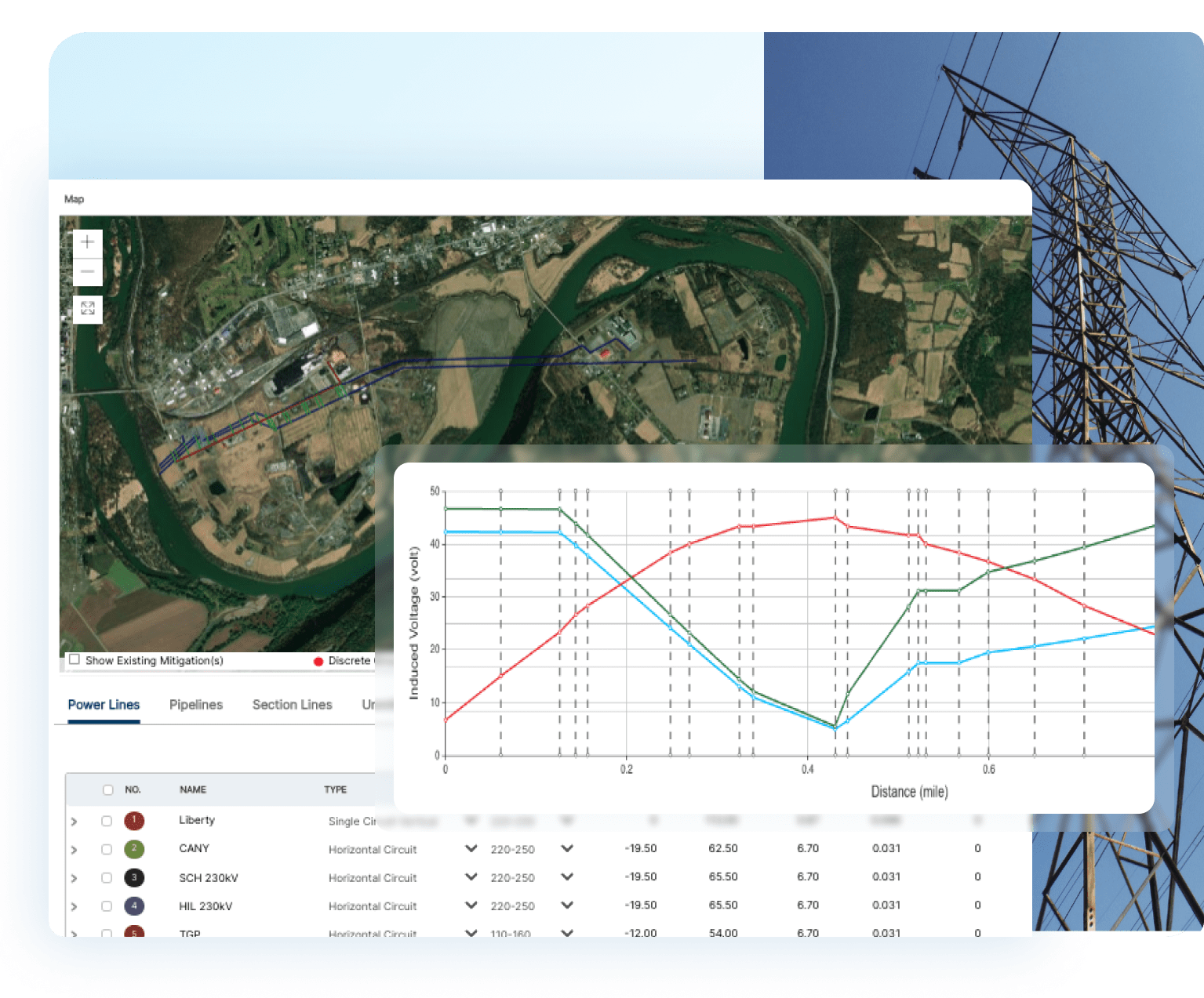

- What Is AC Interference on a Pipeline?
- Five Situations That Signal You Need a Formal AC Mitigation Analysis
- Why Engineers Struggle to Analyze This Without Purpose-Built Tools
- What the AC Mitigation PowerTool Does Differently
- This Is the Right Time to Get Current on AC Interference
- Want to See Our Software in Action?
By: Joe Pikas
You’re reviewing CP/AC survey data on a pipeline segment that runs alongside a high-voltage transmission corridor. The readings look off the chart. Coupon current densities are unusually high. You’re not sure if it’s an instrumentation issue, a coating problem, or something else entirely, but something isn’t right.
If that scenario sounds familiar, there’s a good chance AC interference is part of your problem. And if you haven’t formally analyzed it, you may be dealing with more risk than you realize.
This post breaks down what AC interference is, the project situations that require a formal analysis, what happens when engineers try to handle it manually, and the purpose-built software that changes the equation.
What Is AC Interference on a Pipeline? 
When a buried pipeline runs in proximity to an AC-powered transmission line, the power system exerts electromagnetic influence on the pipeline in three ways: inductive coupling (from the alternating magnetic field around the conductors), capacitive coupling (from the electric field between energized conductors and nearby aboveground structures), and resistive coupling (from fault current traveling through the earth to the pipeline).
The result is induced AC voltage and current on the pipeline that wasn’t designed to carry it. Under steady-state conditions, normal powerline operating loads, this shows up as elevated AC potentials and accelerated corrosion at coating defects. Under fault conditions, when a transmission line experiences a short circuit or ground fault, the energy discharged can be orders of magnitude higher, threatening pipeline coating integrity, pipe wall damage, and serious personnel safety hazards at any aboveground appurtenance in the affected zone.
The two governing standards in this space are NACE SP21424, which covers AC corrosion risk assessment and monitoring, and AMPP SP0177, which covers the full scope of AC and lightning mitigation for metallic structures and corrosion control systems.
Five Situations That Signal You Need a Formal AC Mitigation Analysis
1. Your Pipeline Runs in a Shared Corridor With High-Voltage Transmission Lines
This is the most straightforward trigger. Any pipeline that parallels or crosses high-voltage AC power lines, particularly at 115 kV and above, is subject to inductive coupling. The longer the parallel exposure and the higher the line current, the greater the induced voltage on your pipeline.
What many engineers don’t account for is that the effect isn’t limited to lines directly overhead. Remote encroachments, power lines that run parallel on a separate right-of-way some distance away, can still induce measurable AC potentials on your pipeline depending on soil resistivity, separation distance, and line geometry.
If you’ve never run a formal AC interference study on a segment in this situation, you have an unknown risk on your hands.
2. The Power Lines on Your Corridor Have Been Upgraded
This is the issue that’s catching operators off guard right now, and it’s accelerating. Power companies across the U.S. are reconductoring existing transmission lines: replacing conventional conductors with advanced conductors that can carry two to three times the current load on the same towers, at a fraction of the cost of building new lines. These projects move three to five times faster than new transmission construction, and power companies have no legal obligation to notify adjacent pipeline operators when they do it.
A transmission line that was carrying 1,500 amps of load current when your AC study was done could be carrying 7,500 amps on emergency load today. The induced steady-state voltages on your pipeline have changed accordingly, and your existing mitigation system may be significantly undersized for the new load profile.
If your AC interference study is more than two years old and your corridor includes any high-voltage transmission infrastructure, it is worth verifying that nothing has changed.
3. Your CP Survey Data Doesn’t Add Up
Unexplained anomalies in cathodic protection data are often the first field indication of an AC interference problem. Signs that should trigger an AC evaluation include:
- Coupon current densities (150 A/m² ) exceeding 30 A/m² (above the threshold associated with AC corrosion risk per NACE SP21424)
- Alternating polarity readings or erratic pipe-to-soil potential measurements
- Unexpected coating deterioration on segments with no mechanical damage explanation
None of these are definitive proof of AC interference on their own, but any one of them on a segment in a shared corridor warrants a closer look.
4. You Have Aboveground Appurtenances in an AC-Influenced Zone
Valves, risers, test stations, scraper traps, meter stations, anywhere a person can contact the pipeline structure is a potential shock hazard if AC potentials are present. AMPP SP0177 defines a steady-state touch voltage of 15 V or more as a personnel shock hazard condition, and requires that aboveground appurtenances in affected areas be assessed and mitigated with gradient control mats, dead-front test station construction, or other protective measures.
This isn’t just a corrosion issue. It’s a personnel safety and OSHA exposure issue. An engineer or technician conducting a routine CP survey at a test station in an AC-influenced corridor could be at risk if touch voltages haven’t been evaluated and addressed.
5. You Need to Demonstrate PHMSA Compliance
The PHMSA Mega Rule (49 CFR Parts 192 and 195) requires operators to maintain traceable, verifiable, and complete (TVC) records supporting their integrity management programs. For segments where AC interference is a known or potential threat mechanism, which means documented analysis, not a spreadsheet that lives on one engineer’s laptop, not a study from a previous operator, and not an analysis that predates significant changes to adjacent power infrastructure.
Regulatory auditors are looking for defensible, current, well-documented analyses. An AC interference study that can’t demonstrate it accounts for actual present-day load conditions on adjacent transmission lines is a compliance vulnerability.
Why Engineers Struggle to Analyze This Without Purpose-Built Tools
The physics behind AC interference analysis involves simultaneous modeling of transmission line geometry, conductor load profiles, soil resistivity as a function of depth, pipeline coating resistance, grounding system characteristics, and fault current scenarios. Getting any one of these variables wrong compounds the error across the entire model.
Most engineers who approach this for the first time use spreadsheets. The problems with that approach are well-documented:
- Spreadsheets don’t natively handle the distributed-parameter modeling that accurate AC interference analysis requires
- They can’t integrate GIS data to accurately represent real-world pipeline and power line geometry
- Fault current scenarios and coating stress voltage calculations are difficult to model correctly without validated formulas built specifically for this application
- Results are hard to document in a format that satisfies TVC requirements
- When input parameters change — as they will every time power line loads change, every calculation has to be manually rebuilt
The result is an analysis that takes far longer than it should, is prone to errors that go undetected, and produces outputs that are difficult to defend to regulators or use confidently in mitigation design decisions.
What the AC Mitigation PowerTool Does Differently
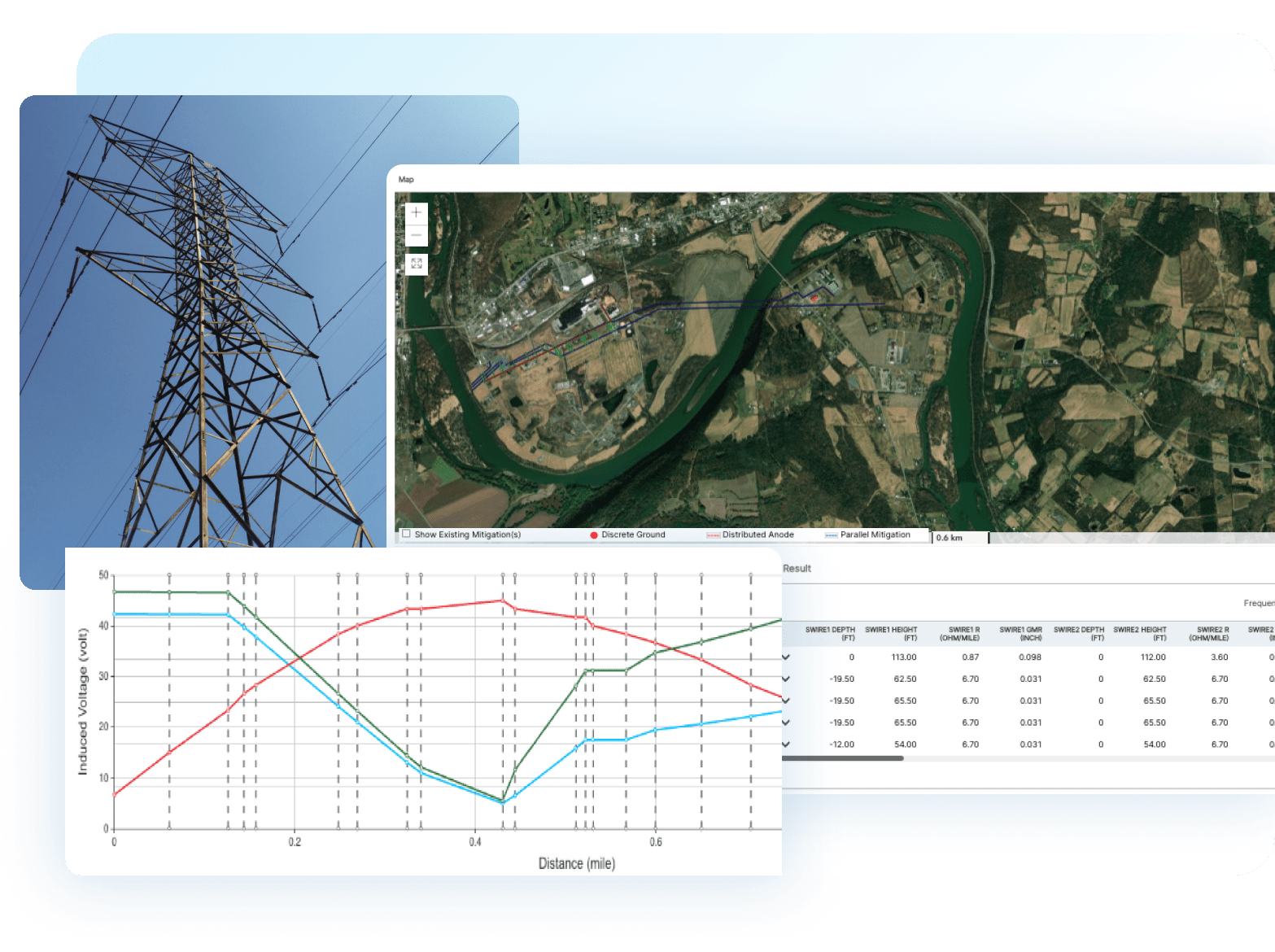
The AC Mitigation PowerTool (ACPT) from Technical Toolboxes is purpose-built for exactly this problem. Developed based on PRCI research and built to meet all NACE/AMPP standards for AC corrosion analysis, it gives engineers a single, validated environment to model, map, and mitigate pipeline corrosion caused by AC interference.
- Comprehensive analysis in one platform. ACPT handles steady-state and fault condition modeling together, including AC voltage identification, corrosion risk assessment, coating stress voltage calculations, and step, touch, and surface potential analysis at aboveground appurtenances. You’re not stitching together results from separate tools.
- Built for real pipeline geometry. ACPT integrates directly with ESRI GIS, allowing you to import GIS/Shape files, KMZ, KML, geodatabase, and lat/long data. Your model reflects the actual geometry of your pipeline and adjacent power infrastructure, including depth of cover variations and HDD road and water crossings.
- Barnes layers measurements and soil resistivity. ACPT accounts for soil resistivity changes along the corridor and includes Barnes layer analysis, so your model reflects what’s actually in the ground, not a simplified assumption.
- Mitigation design built in. Once you’ve identified where potentials exceed safe thresholds, ACPT helps you design the mitigation: gradient (parallel) control wires, fault shields, lumped grounding, and other measures sized for your actual load and fault current scenarios.
- Compliant, report-ready output. Generate AC interference reports with a single click. All data is stored centrally, supporting the TVC documentation requirements under PHMSA’s Mega Rule and giving you an auditable record of your analysis and mitigation decisions.
This Is the Right Time to Get Current on AC Interference
The grid is changing faster than most pipeline operators realize. Reconductoring projects are underway across the country, quietly doubling and tripling the capacity of transmission lines that share corridors with pipelines. The updated AMPP SP0177 standard is being finalized with new guidance on fault condition design objectives and personnel safety requirements at aboveground appurtenances. And PHMSA scrutiny of AC-related integrity threats is only increasing.
If you’ve been managing AC interference with a spreadsheet, a study that’s a few years old, or no formal analysis at all, now is the time to control those AC currents.
LIVE WEBINAR • JUNE 24
“AC Interference: The Problem Just Got Bigger”
Hosted by Joe Pikas — lead contributor on the new AMPP SP0177 standard revision
Joe will walk through what reconductoring is, how it’s changing the AC interference picture for operators across the country, what the updated SP0177 standard requires, and how to use AC Mitigation PowerTool to model your risk and design defensible mitigation — live.


Suggested Post
AC Interference on Pipelines: What It Is, Why It’s Getting Worse, and How to Fix It
By: Joe Pikas You’re reviewing CP/AC survey data on a pipeline segment that runs [...]

The Inspection Data Problem Is a Business Risk. Here’s What Operators Are Doing About It- with HUVR
The Inspection Data Problem Is a Business Risk. Here's What Operators Are Doing About [...]

Modern Gas System Modeling: Why Magnolia River Trusts GASWorkS to Keep the Pressure Up (Literally)
Modern Gas System Modeling: Why Magnolia River Trusts GASWorkS to Keep the Pressure Up [...]